


- 93
- 0
Sharing Ideas and Updates on LPG in Nigeria and related information to enable effective collaboration within the LPG Value Chain

COOKING GAS INCREASED BY 9.5% IN FEBRUARY 2026
COOKING GAS INCREASED BY 9.5% IN FEBRUARY 2026

To gather data, we always carry out our survey nationwide using social media platforms, our retail sellers, and end-users.
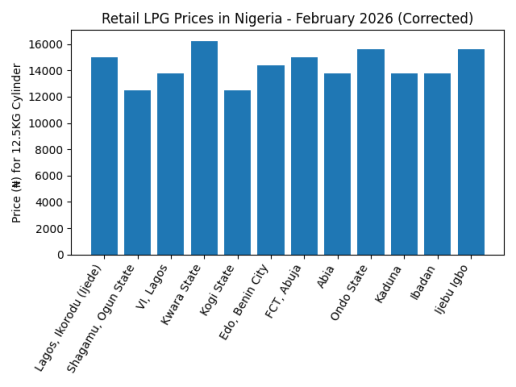
The February 2026 retail price survey for Liquefied Petroleum Gas (LPG) across selected Nigerian cities shows moderate price variation driven mainly by location, transportation costs, depot access, and regional demand levels. The data reflects prices for a 12.5kg cylinder, which remains the most widely used household cooking gas size in Nigeria.
Across the surveyed markets, the average retail price of a 12.5kg cylinder stood at ₦14,322.92 during February 2026. This suggests that the national market largely traded within a ₦13,500 – ₦16,250 price band during the month.
The average retail price of LPG increased between January and February 2026. In January, the average price stood at ₦13,080, while in February it rose to ₦14,322. This represents an absolute increase of ₦1,242 within the one-month period. When expressed as a percentage, the increase amounts to approximately 9.5%. In practical terms, this means the average cost of refilling a 12.5kg cooking gas cylinder rose by nearly one-tenth in just one month. Such an increase suggests tightening supply conditions, higher depot prices, transportation costs, or broader market adjustments within the LPG value chain. For households and small businesses that depend heavily on cooking gas, a 9.5% month-on-month rise is significant and highlights how sensitive Nigeria’s LPG market can be to supply dynamics and distribution costs.
Major Market Observations
Urban markets with stronger supply access, particularly within the Lagos supply corridor, showed relatively competitive pricing. In Ikorodu (Ijede), Lagos, the price of a 12.5kg cylinder averaged ₦15,000, translating to approximately ₦1,200 per kilogram. Similarly, Victoria Island, Lagos, recorded slightly lower prices at ₦13,750, reflecting strong competition among retailers and easier access to coastal supply depots.
Markets in Shagamu (Ogun State) and Kogi State recorded some of the lowest prices during the month at ₦12,500 per 12.5kg cylinder. These prices reflect periods of improved supply availability and competitive local retail pricing.
On the other end of the spectrum, Kwara State recorded the highest retail price at ₦16,250, equivalent to ₦1,300 per kilogram. This increase can largely be attributed to inland transportation costs, supply chain logistics, and depot sourcing distances.
Similarly, markets in Ondo State and Ijebu Igbo recorded prices of ₦15,625, indicating that secondary markets in the Southwest continue to experience slight price premiums compared to areas closer to major LPG storage terminals.
In Abuja, Nigeria’s capital, the average retail price stood at ₦15,000, reflecting stable supply but relatively higher operating costs typical of the Federal Capital Territory market.
Cities such as Abia, Kaduna, and Ibadan maintained relatively stable prices around ₦13,750, suggesting balanced supply and steady demand conditions during the period.
Benin City (Edo State) recorded a retail price of ₦14,375, positioning the market close to the national average and reflecting relatively stable supply flows from southern distribution corridors.
Key Market Insights
Overall, the February 2026 data reveals three important trends within Nigeria’s LPG market.
First, geographic location continues to be a major determinant of retail LPG pricing. Cities closer to coastal import terminals or major storage facilities generally enjoy lower prices than inland markets that depend on longer transportation routes.
Second, the relatively narrow national price band suggests that market competition among LPG retailers remains active, helping to prevent extreme price disparities.
Third, the national average of ₦14,322 for a 12.5kg cylinder indicates a moderate price environment compared to previous high-price cycles observed in earlier years when supply shortages and foreign exchange pressures significantly drove up LPG prices.
Market Outlook
If domestic refining capacity and gas processing output continue to expand, Nigeria could see improved supply stability in the LPG market, which may gradually reduce regional price differences.
However, prices will continue to be influenced by:
depot pricing behaviour
transportation costs
exchange rate movements
seasonal demand fluctuations
infrastructure development across the LPG distribution network
For households and small businesses that rely heavily on LPG for cooking and energy needs, a stable supply remains just as important as price levels.
We are currently noticing an upheaval in the LPG market this March, and we will give you reports on that by the end of the month.
Share on Social Media:
Are you setting up, or do you need LPG information? Get started with our LPG and CNG Webinars!
Do you need LPG Depot Prices and Mont Belvieu Prices Data Sheet (2019 till date)? Get Access here!
You May Also Like




0 Comment.